Project 07 · Case study
Molecular transport analysis
Methane Self-Diffusion Study
A trajectory-analysis workflow for converting molecular motion into mean-squared displacement, diffusion coefficients and finite-size-corrected transport data.
Compare unwrapped trajectories
400 K · 358.4 kg/m³
Related solver
Built on the methane MD solver
This study extends the verified NVT solver with unwrapped position output and a dedicated post-processing workflow.
View Project 02
Trajectory method
Motion without periodic wrapping
Unwrapped coordinates preserve the true displacement of every molecule as it crosses a periodic boundary.
Store origins
Position snapshots become time origins at a fixed sampling frequency.
Accumulate motion
Particle displacements are evaluated over many correlation-time windows.
Average MSD
Squared displacements are averaged across molecules and available time origins.
Fit diffusion
The long-time linear region is converted into a self-diffusion coefficient.
Einstein relation
Mean-squared displacement
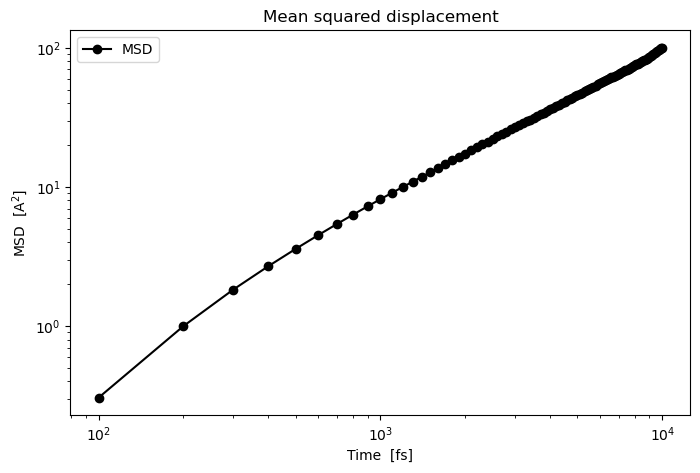
Diffusion emerges from the long-time slope
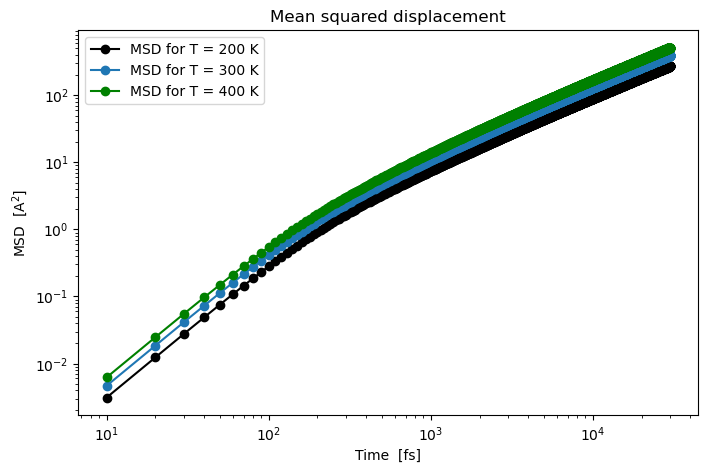
The logarithmic MSD response becomes nearly linear at long correlation times.
A multi-origin algorithm improves statistical use of the trajectory by reusing many time origins instead of relying on one initial frame.
Finite-size study
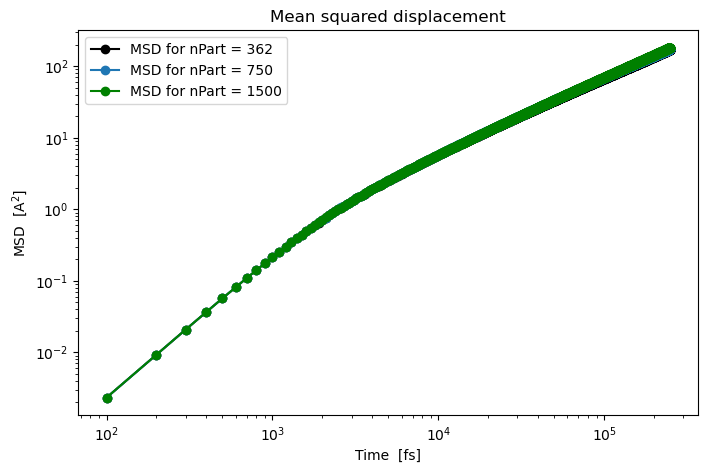
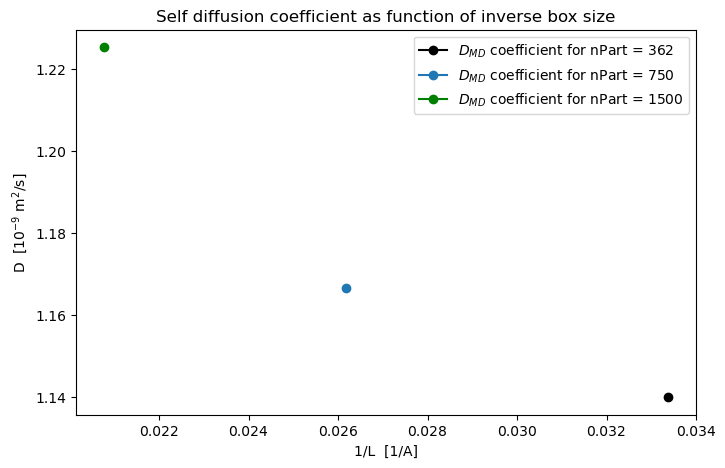
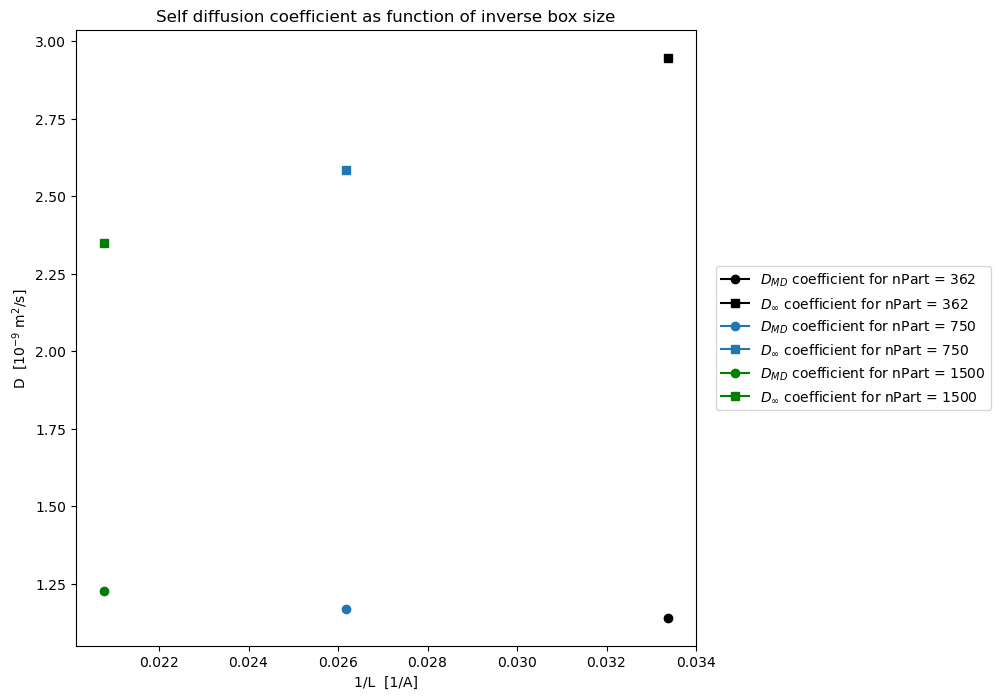
Measuring the box-size effect
Three particle counts were simulated at the same density and temperature to test the effect of periodic box size.
Engineering interpretation
The result was treated as a model-diagnostics finding. It shows that the correction is sensitive to the viscosity input and the consistency between the molecular model and the external fluid property.
Temperature dependence
Faster motion at higher temperature
The 400 K trajectory produces the highest MSD and the 200 K trajectory the lowest.
This monotonic trend carries through to the extracted self-diffusion coefficients.
Literature comparison
Transport results against published values
Corrected diffusion values follow the expected temperature trend and remain closest to the literature values at 200 and 400 K.
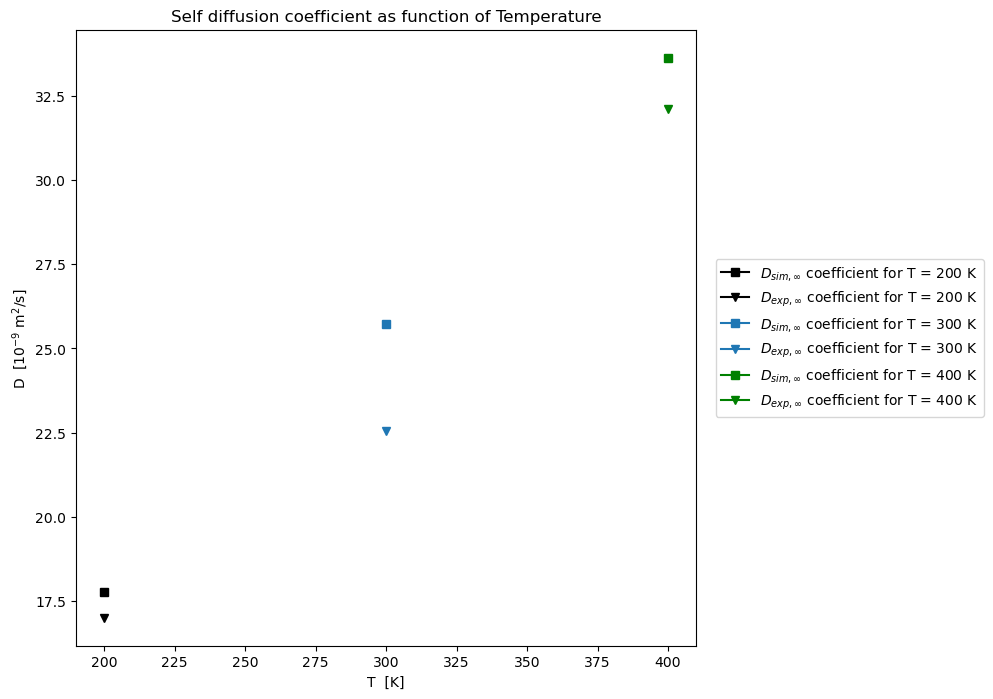
Approximately 4.6% higher.
Approximately 14.0% higher.
Approximately 4.8% higher.
Diffusion coefficients shown in 10−9 m²/s.
Engineering outcome
From trajectories to validated transport data
The project extended a custom MD solver into a complete transport-property workflow.
It combined unwrapped trajectory output, multi-origin MSD, finite-size analysis, correction diagnostics and comparison with published methane data.